
Squishy toys are soft toys that change shape when you squeeze them by hand. Some recover gradually; others return more quickly. They come in familiar shapes such as food and animals, but the shape—and the word “squishy”—does not tell you what a toy is made from or whether it contains a separate filling.
That distinction matters when you compare products. Two dinosaur-shaped toys can look similar in photographs and still have different constructions or squeeze differently.
Shape describes the design, not the construction
The squishy toy catalog includes hot dogs, peanuts, bananas, dinosaurs and axolotls. These names help you find a design. They do not identify its outer material, filling or recovery speed.
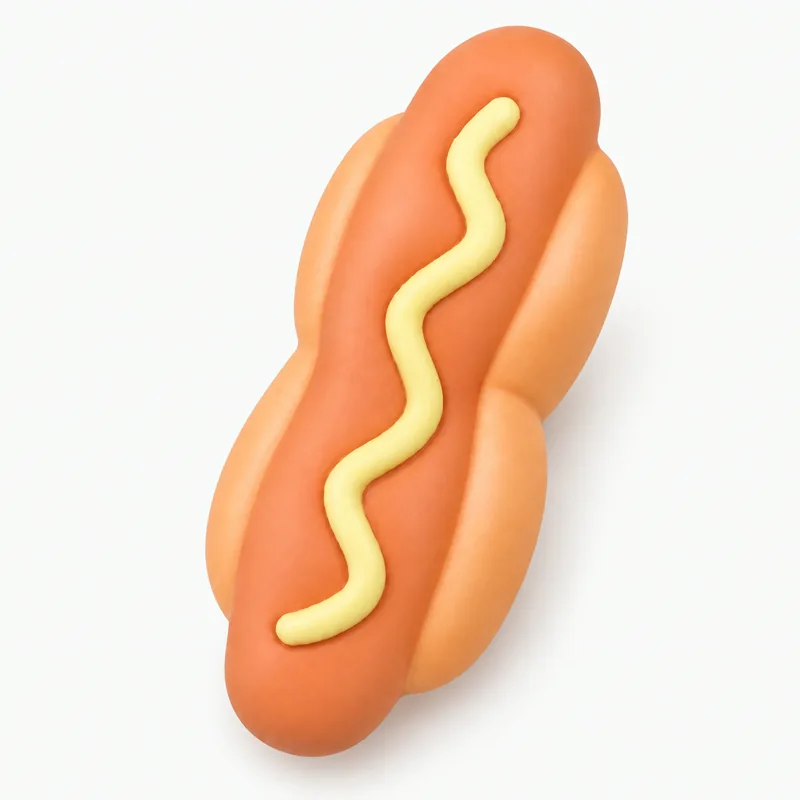
A squishy may have a foam body, a solid flexible body, or a flexible outer shell around a separate filling. The category includes foam, rubber and silicone products, as explained in the ACCC squishy toy guide. Individual product descriptions are needed to understand the construction of a particular toy.
For example, the large hot dog squishy is listed with a thermoplastic rubber (TPR) outer shell and flour filling. That is a description of this item, rather than a definition of all hot dog shapes or all squishy toys.
The dinosaur squishy makes the distinction especially clear. It has two listed versions: a TPR outer shell with block-clay filling, and a TPR outer shell with flour filling. Choosing the dinosaur shape alone therefore leaves an important part of the product unspecified.
What the common names tell you
“Squishy” is the singular name; “squishies” is the plural. Both refer to the general toy category. “Squeeze toy” describes what you do with it: press or squeeze it in your hand.
“Slow-rising” describes gradual recovery after squeezing. It is a description of behavior, not a material name. Squishy toys do not all recover at the same speed, so there is no single recovery time that applies to the whole category.
“Stress ball” and “fidget toy” describe overlapping uses. A buyer might search under either term for something to hold and squeeze, but neither term specifies a filling or proves a therapeutic benefit. A product still needs its own description.
These names can appear together without answering the same question. “Dinosaur” tells you the appearance, “squeeze toy” describes the hand action, and “slow-rising” describes recovery. None of those labels, by itself, establishes the full construction.
How to read a product description
When you find a design you like, look beyond its name. A useful description separates:
- The shape and dimensions of the toy.
- The outer material and whether there is a separate filling.
- The available product versions.
- Any stated recovery behavior.
If one of these details is missing, leave it as an open question rather than filling the gap from a photograph. A picture can help you compare visible shapes and details, but it cannot establish material composition or squeeze feel.
Keep age and care instructions with the individual product as well. A category name does not provide those instructions. Once you separate appearance, construction and behavior, similar-looking squishies become much easier to compare.

