
Compare each squishy toy’s uncompressed length, width and height using the same orientation and units. Then compare the complete packed item separately. A single size number, or a label such as “mini” or “jumbo”, does not tell you all three dimensions, whether the toy will fit your packaging, or how it will feel when squeezed.
For a custom bulk order, start with the constraint that matters to your project: the usable space inside a package, the proportions you want on a display, or the hand feel you expect from the sample. That gives the size comparison a practical purpose and helps you explain what needs to be agreed before production.
Find out what the listed size measures
Size labels vary between product listings. A “mini” version from one supplier may not use the same dimensions as a “mini” version elsewhere, so compare the measurements of the individual product version rather than assigning a fixed range to the label.
A listing that says “14 cm” still leaves an important question unanswered: which dimension does that number describe? It might refer to the longest direction, but you should not assume that. Ask for the length, width and height, with the orientation shown or described.
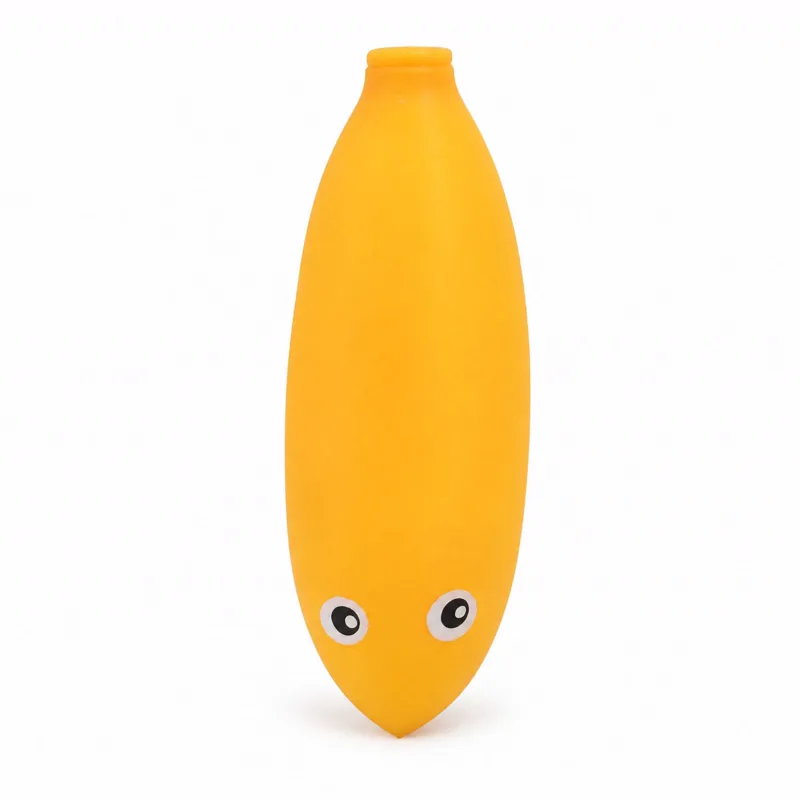
Irregular shapes need clear measurement points too. A banana’s curved body and projecting tip make its outline different from a pencil shape. Agree where each measurement begins and ends, and whether any projecting features are included. Labeled views can make those details easier to understand than a dimension written without context.
Measure a soft sample in its resting shape
A useful comparison starts with the toy resting without being squeezed or stretched. If it has just been handled, allow it to return to its resting shape according to its product instructions before measuring.
Keep the orientation consistent between samples. Turning one reference onto its side while leaving another upright can change which direction you call its height, making the figures difficult to compare. A ruler beside the sample, together with labeled views showing the chosen endpoints, gives the supplier and buyer a shared reference.
For a custom version, record the sample identity as well as the dimensions. The measurements need to belong to a particular shape and version, especially if the proposed order changes the size or packaging. Before ordering, the buyer and supplier can agree on the measurement method and acceptable dimensional variation.
Put centimetres, millimetres and inches on the same basis
Use one unit across your comparison. One centimetre equals 10 millimetres, so 14 cm is 140 mm. For inches, NIST’s unit conversion table gives 1 inch as 2.54 centimetres. Multiply inches by 2.54 to obtain centimetres, or divide centimetres by 2.54 to obtain inches. For example, 4 inches is 10.16 cm.
Keep the original measurement alongside the conversion when preparing a reference. Converting an approximate figure into more decimal places does not make the source measurement more precise. “About 4 inches” remains approximate when expressed in centimetres.
What the banana and pencil listings tell you
The 14 cm banana squishy and 15 cm pencil squishy provide a useful example of why one size number and one weight figure are not enough for a complete comparison.
| Listed specification | Expressive Banana Squishy Toy | Pencil Squishy Toy |
|---|---|---|
| Size | 14 cm; one size number supplied | 15 cm; one size number supplied |
| Unit weight | 80 g | 80 g |
| Construction | TPR shell with flour filling | TPR shell with flour filling |
| Dimensions still needed | Complete length, width and height, with measurement points | Complete length, width and height, with measurement points |
These are the specifications published on the product pages, not independent measurements. The single size figures do not establish their measurement endpoints or which toy occupies more space.
The equal listed weights also do not establish equal firmness or squeeze feel. Weight and dimensions answer different questions: two toys can share a unit weight while having different shapes and proportions. Handling also depends on construction and filling, which cannot be deduced from an 80 g figure. If hand feel matters to the range you are developing, assess the proposed sample rather than choosing from size and weight alone.
Separate toy size from package and carton size
A toy’s dimensions describe the product itself. An individually packed unit includes its packaging, which can add to the overall dimensions. Inside that package, an insert or a narrow opening may constrain the fit even when the main cavity appears large enough.
Measure the intended package’s usable internal space and assess the actual packed sample. Do not rely on compressing the toy to make it fit or assume it can be stored under compression. For a display, the complete packed item is also the relevant reference when deciding how much space each unit needs.
The shipping carton is a third measurement. Product-only dimensions cannot establish shipping charges, and toy-only unit weight is separate from the packed unit’s weight or a carton’s gross weight. A shipping estimate needs confirmed packed dimensions, the carton configuration and the gross weight for the proposed order. The packaging inquiry guide can help you describe the individual packaging and carton requirements together.
Turn the comparison into a clear sample request
Before requesting a bulk sample, bring together the exact product reference, its stated dimensions and any missing measurements. Add the size constraint you need to meet, the intended packaging and the hand feel you want to assess. If you are asking for a size change, distinguish the current reference from the proposed version.
A request can be straightforward:
We are considering this shape for a custom bulk order. Please provide its uncompressed length, width and height, with labeled views showing the orientation and measurement points. We also need to assess it in our proposed packaging. Please advise whether the requested size change is available and how a sample can be arranged.
For approval, tie the agreed dimensions, measurement method, acceptable variation and packaging to an identifiable sample. The sample approval guide provides a way to keep those decisions connected to the version being approved.
Bulk Squishy Toys accepts custom wholesale inquiries. Available size changes, sample arrangements, packaging and order terms need confirmation for your proposed project. To discuss a custom bulk order, send the product reference and the size constraints that matter to your package, display or sample assessment.

