
To assess a custom squishy toy order, get the minimum quantity for the exact product and the way you want to divide the order. Confirm the toy and packaging conditions separately, then ask for the sample, approval, production, dispatch and arrival milestones, including what must happen before each stage can begin. A general minimum or a production-day estimate alone does not establish whether your proposed order fits your budget and receiving deadline.
Bulk Squishy Toys accepts custom wholesale inquiries. The minimum quantity, feasible assortment, sample arrangements and dates for your selected products need to be confirmed in the project quotation.
Find out what the minimum applies to
MOQ means minimum order quantity: the least quantity a supplier accepts under the applicable order conditions. It is useful to distinguish that minimum from order multiples and restrictions on individual colors or sizes, as explained in Shopify’s guide to minimum order quantities. These are general purchasing concepts; they do not establish a quantity offer for your Bulk Squishy Toys project.
Start with exact product references from the squishy toy catalog. For each reference, list the requested version, color, quantity and package. An overall total can hide a quantity split that does not meet the proposed conditions.
Ask whether the quoted minimum applies to each design, color, package, production run or complete order. If you want to combine colors or designs, request written confirmation that the specific combination is acceptable. Do not assume that several small quantities qualify simply because their total exceeds a stated minimum.
For example, consider a purely illustrative order of 900 toys divided evenly across three colors: 300 per color. If a hypothetical quotation requires 400 per color, keeping all three colors would require 1,200 toys. Those figures are an arithmetic example, not an actual minimum or available offer. The buyer could ask about fewer colors or request a separately quoted alternative.
Separate toy quantities, packaging quantities and carton multiples
A toy minimum does not answer every packaging question. Confirm whether custom printing, boxes, labels or the requested assembly arrangement has a separate minimum. Also establish whether a selling set contains one toy or several, so that “units” has the same meaning on both sides of the quotation.
Keep these quantities distinct:
- Toys: the number of toys in each agreed product version and color.
- Packages or selling sets: the number of individual packages or sets, with their contents specified.
- Outer cartons: any required full-carton quantities or packing multiples.
A full-carton multiple is a packing condition and should be identified separately from the product minimum. Ask how the proposed quantities will be packed and whether meeting that condition changes the number of toys you must purchase.
If a custom package requires more pieces than the toy order uses, clarify what you are buying and paying for. Agree who will hold any remainder, whether later use is possible and what charges or other conditions apply. Storage, future use and credits need explicit agreement. The packaging inquiry guide can help you specify the individual package, selling set and outer packing separately.
Define the version before relying on the timetable
An existing-shape request and a new-shape development request can involve different work. Describe the proposed shape, color, decoration and package, then ask which tooling, samples or approvals are required for that version. The quotation should explain how those requirements affect both quantity and timing.
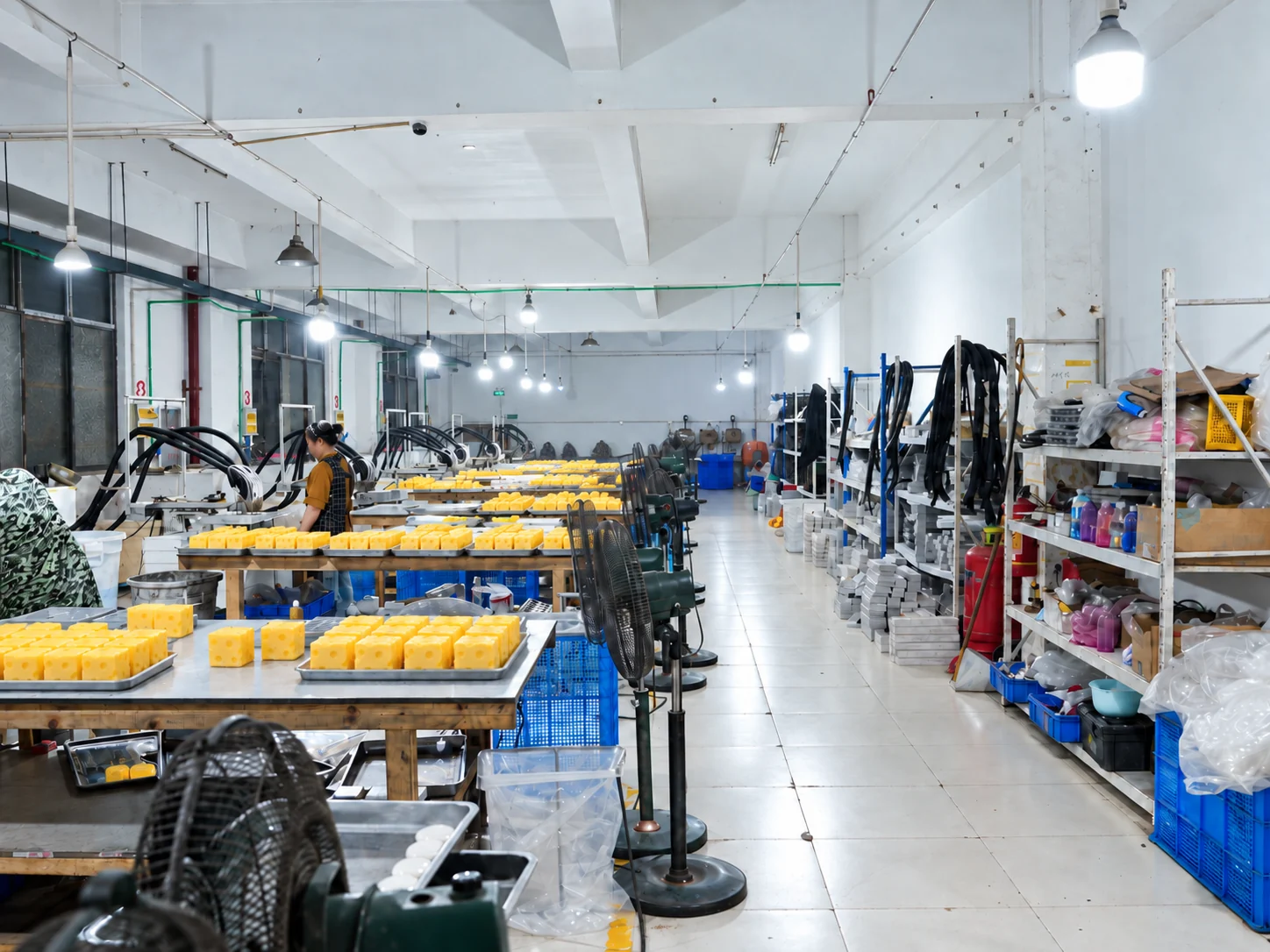
An existing mold does not by itself establish that finished stock is available or that a production slot has been reserved. Likewise, a workshop photograph may show workers, tables and toys, but it cannot establish capacity, current production availability or the ability to rush your order. Ask for the conditions and dates that apply to the proposed project.
Agree what the sample represents and how approval works
Before planning around a sample date, confirm which product version the sample will represent. Establish whether it includes the proposed decoration and packaging, and identify anything that will differ from the bulk order.
Agree the sample cost, delivery arrangements, revision process and what counts as approval. Ask how revisions will be handled and whether they require a new quotation or timetable. Sample fees and any later credits are not automatic.
Make the approval event clear enough for both parties to recognise. That may require identifying the sample version and confirming the agreed specification in writing. Use the sample approval checklist to work through the approval details.
Ask where the quoted lead time starts and ends
A quoted production period needs both a starting point and an endpoint.
Ask whether the estimate starts after written specification approval, sample approval, an agreed payment event or another stated condition. If several conditions must be met, identify all of them. Also confirm whether the quotation uses working days or calendar days.
The endpoint matters just as much. Production completion, finished packing and dispatch are different events. A production estimate cannot be treated as an arrival estimate unless the remaining stages are expressly included.
| Milestone | What to confirm |
|---|---|
| Sample preparation and dispatch | Which version will be prepared, what starts the work and when the sample is expected to be sent. |
| Buyer approval or revisions | What the buyer must approve, how revisions are handled and when the approved version becomes final. |
| Production completion | The starting conditions, the agreed completion point and whether days are working or calendar days. |
| Packing and inspection, if agreed | What is included and where these activities sit in the confirmed sequence. |
| Shipment handoff | When and where the shipment is expected to be handed over for transport. |
| Transit and receiving | The destination, required receiving date and which transport or destination activities the estimate includes. |
Ask the supplier to confirm the sequence. Some activities may overlap if the project allows it; others may depend on an earlier approval. Do not simply add every stage duration together, or assume that two stages can run at the same time.
Plan from the date you need to receive the goods
Give the supplier your required receiving date and destination, rather than only asking for the earliest production finish. State whether the goods need to reach your warehouse, a fulfilment partner or another named receiving point.
Then ask what any delivery estimate includes. Confirm the distinction between production completion, shipment handoff and arrival at the receiving point. Do not assume that freight, destination handling or every step before warehouse receipt is included in a quoted production or dispatch date.
If the proposal depends on you approving a sample or specification by a particular date, record that deadline alongside the receiving target. This makes the buyer’s part of the schedule visible before the order is committed.
If the quantities or dates do not fit, request a specific alternative
Identify the condition that prevents the proposal from working. It may be a per-color minimum, a separate packaging quantity, development work or a milestone that falls too close to the required receiving date.
Ask for a written alternative with fewer versions or a different feasible decoration or package. Keep the revised quantities and timing conditions explicit. A smaller order does not by itself establish faster delivery or a lower unit price.
If you change the shape, color, printing, quantity or packing after approval, ask the supplier to reconfirm the affected minimums, approved version and dates. The effect depends on the change and the project; a previous estimate should not be carried forward without checking.
Approve the quantity and schedule only when every order line and starting condition is clear. If something remains unanswered, name that condition and request a revised proposal before committing. To discuss your custom wholesale order, send the chosen product references, quantities for each version and color, proposed packaging, destination and required receiving date.

