
Squishies can have foam, rubber or silicone bodies. Some use a flexible outer shell with a separate filling, such as gel, beads or water. Others compress through the material of the body itself, without a separate filling. These are examples across the wider toy category, as described in the ACCC squishy toy guide; they do not describe the product range available from Bulk Squishy Toys.
For a bulk buyer, the useful question is which part of the toy a material name describes. PU, TPR and silicone name materials. Gel, flour filling and block-clay filling describe something inside a filled product, but provide different levels of detail. A listing that gives only one of these terms may leave part of the construction unexplained.
Start with the body, then check whether there is a filling
A foam-bodied squishy has a cellular material throughout its body. It can compress without a separate pouch of liquid inside. A molded flexible solid body is another construction. In a filled squishy, the outer shell contains a separate material.
These distinctions matter when comparing listings. “PU foam body” and “TPR shell with flour filling” describe different constructions. “Soft squishy” tells you much less.
| Part described | What to establish |
|---|---|
| Body | The material forming the toy itself, such as foam or a flexible solid material. |
| Outer shell | The material enclosing a separate filling. |
| Filling | The material inside the shell, identified separately from the shell material. |
What PU foam, TPR and silicone tell you
PU foam
PU means polyurethane. Polyurethane can form flexible foam as well as other materials, so “foam” is a meaningful part of the description.
Viscoelastic polyurethane foam is an open-cell flexible foam that recovers gradually after compression. Its formulation, along with surrounding temperature and humidity, can affect firmness and recovery. The Polyurethane Foam Association’s explanation of viscoelastic foam covers this general behaviour. It does not give a recovery time for a particular squishy toy, and “PU” alone does not establish how slowly a product will rise.
TPR
TPR means thermoplastic rubber, within the broader thermoplastic elastomer family. If a listing says “TPR shell”, it identifies the shell material category. It does not identify the filling or disclose the complete formulation.
That makes the rest of the description important: two versions can share a TPR shell while containing different fillings.
Silicone
Silicone rubber can be formulated to be very soft and stretchy. However, the word “silicone” does not promise one fixed feel or establish a particular toy’s durability. Nor can a rubbery texture reliably distinguish silicone from rubber or a thermoplastic elastomer. Avient’s guide to thermoplastic elastomers explains why appearance and feel are insufficient to identify these materials.
What can be inside a filled squishy?
Gel, beads and water are possible fillings in the wider category. A filling name should be read alongside the shell description and the exact product version.
For a concrete example, Bulk Squishy Toys lists its dinosaur squishy with two filling options: a TPR shell with block-clay filling, and a TPR shell with flour filling. Both versions share the pictured blue dinosaur shape. The photograph shows the design; it does not settle which filling you are ordering.
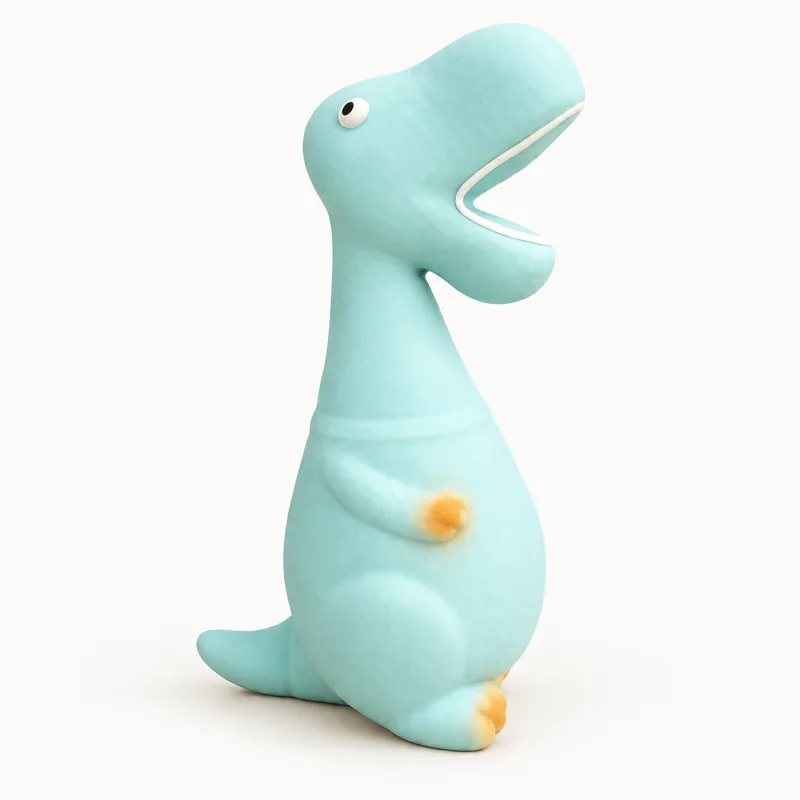
“Flour filling” and “block-clay filling” are the names used for those versions. Neither is a complete ingredient list. They do not establish that the contents are edible, food-grade, allergen-free or natural. If composition is relevant to your purchasing requirements, ask for product-specific information rather than drawing conclusions from the filling name.
Can colour or slow recovery identify the contents?
No. A white, clear or jelly-like filling cannot be assigned an exact composition by appearance. Likewise, watching a toy recover after squeezing does not reveal its complete composition. Slow recovery is an observable behaviour, not an ingredient list.
Do not cut, puncture, heat, freeze or break open a squishy to identify or alter its contents. Follow the manufacturer’s instructions.
Compare the exact versions before approving a bulk order
Ask for the body or shell material and any filling as separate descriptions, tied to the product version under discussion. For the blue dinosaur, “TPR dinosaur” leaves the filling unresolved. “Blue dinosaur, TPR shell, flour filling” identifies the listed version more clearly.
Then request a physical sample and compare its feel and recovery under the product’s instructions. Keep the version recorded with the sample so that an approval refers to something specific. The sample approval guide can help you keep that connection clear. A sample’s feel does not prove composition or compliance, and a material name alone cannot establish which toy is safest, longest-lasting or washable.
Bulk Squishy Toys supplies custom bulk orders only. To send a custom bulk inquiry, include the product link, estimated quantity, destination and any filling choice you still need to resolve. Availability and requested changes need individual confirmation.

